


How to Ship Vinyl Records Safely: A Guide to LP Mailers and Packaging
Vinyl records need careful packaging when they’re shipped. Even if the disc arrives intact, a bent album corner, split jacket seam, or scratched surface can
Need bulk pricing or have a specific shipping request? Contact us!
Bubble wrap is widely used to protect products during shipping, but effective packaging involves more than wrapping an item in a few layers of cushioning. Exposed corners, insufficient padding, or movement inside the shipping box can still leave fragile products vulnerable to damage.
To pack fragile items with bubble wrap, choose suitable cushioning, wrap the item completely, reinforce vulnerable areas, and place it in a sturdy box with enough protection to prevent movement. The material should cushion the product without being compressed so tightly that its air-filled bubbles lose their effectiveness.
Whether you’re packing individual customer orders or preparing shipments in a warehouse, following a consistent process can help improve protection while avoiding unnecessary packaging waste.
Before wrapping an item, gather the materials needed for the complete shipment:
Choose materials according to the product’s size, weight, fragility, and surface characteristics. Heavy, highly fragile, or unusually shaped products may require additional protective packaging beyond conventional bubble wrap.
4Bubble offers bubble wrap rolls for shipping and storage, including standard and recycled options in different sizes.
Start by inspecting the product on a clean, flat surface.
Look for vulnerable areas such as glass surfaces, protruding handles, sharp corners, narrow sections, or delicate finishes. These parts may need additional cushioning because they are more exposed to pressure or impact.
If the product has a polished, painted, or scratch-sensitive surface, consider placing a compatible protective material against it before adding bubble wrap.
For electronic components, check whether specialized static-control packaging is required. Ordinary bubble wrap should not be assumed to provide electrostatic discharge protection.
Bubble wrap is available with different bubble heights and roll dimensions. The size you choose influences how closely the material conforms to an item and how much cushioning depth it provides.
Small bubble wrap, such as 3/16-inch material, is flexible and useful for wrapping compact products, accessories, and irregular shapes.
Large bubble wrap, such as 1/2-inch material, creates greater cushioning depth and can be useful for larger products or packaging configurations that require more separation.
Neither size is automatically better for every fragile item. Consider the complete packaging arrangement, including carton size and any additional protective materials.
For a detailed comparison, see our guide to bubble wrap sizes and their shipping applications.
Cut or tear a section of bubble wrap large enough to cover the product, allowing material to overlap around its sides and edges.
For many general-purpose wrapping applications, the bubble side is placed toward the product so the air cells conform around its shape. However, some shipping guidelines recommend placing the smooth side against the item instead.
Follow applicable carrier or product-specific packaging instructions when available. The overall protection depends more on adequate cushioning, complete coverage, and secure packing than on bubble orientation alone.
If direct contact could mark or damage the product’s surface, use a suitable protective interlayer regardless of which side faces inward.
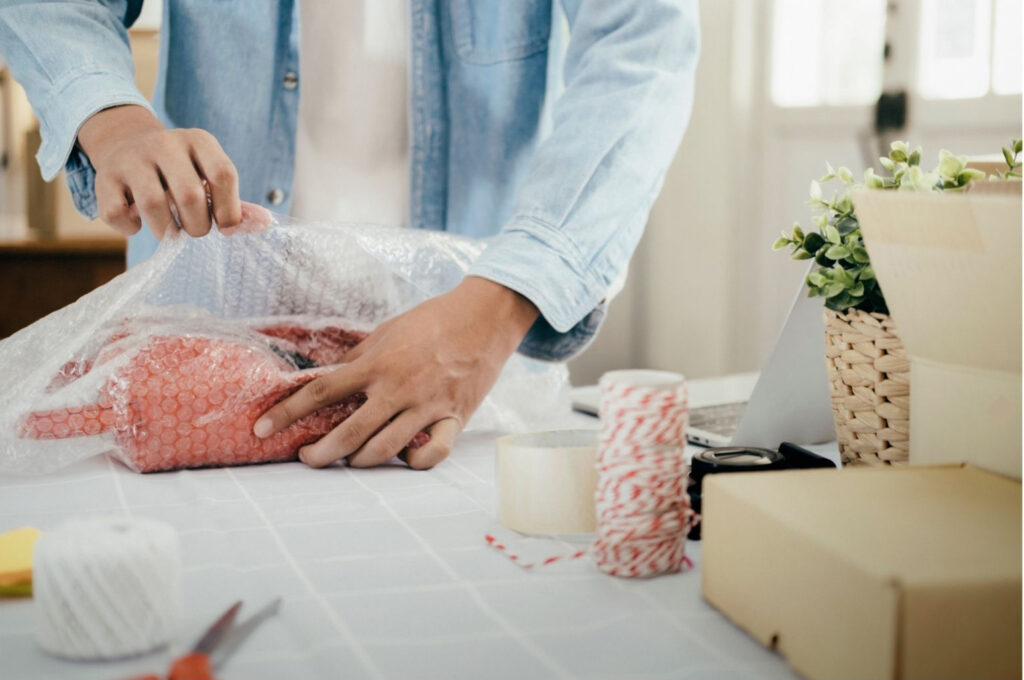
Place the product on the prepared bubble wrap and bring the material around it, overlapping the edges to maintain continuous coverage.
Make sure the sides, corners, and vulnerable areas are protected. If the item has an unusual shape, you may need to use separate pieces of cushioning around handles, projections, or other exposed sections.
For fragile products, multiple wraps may be necessary to provide adequate cushioning.
Avoid pulling the material so tightly that the bubbles are significantly flattened. The air pockets need to retain their structure to perform their cushioning function.
Use suitable packing tape to hold the bubble wrap in place.
Apply the tape to the outer wrapping rather than directly to the product. This is particularly important for painted surfaces, labels, polished finishes, or delicate materials that could be affected by adhesive.
The wrapping should remain secure during handling without creating excessive pressure on the contents.
When packing multiple fragile items, wrap each one individually. Separate cushioning helps prevent products from striking or rubbing against one another inside the same box.
Choose a sturdy corrugated box that accommodates the wrapped product and leaves room for appropriate cushioning.
Add protective material beneath the item before positioning it inside the carton. The product should not rest directly against an unprotected outer wall where it could be exposed to impact.
Fill the remaining spaces around the wrapped item with suitable cushioning or void-fill material. Pay attention to the bottom, sides, and top so that the contents remain supported in all directions.
For particularly fragile items, a double-box packing method may be appropriate, with cushioning between the inner and outer cartons.
Avoid using an oversized box with large empty spaces. Extra room can allow the product to move during transportation unless those gaps are properly filled.
Before sealing the carton, gently tilt it to check whether the contents move.
If the product shifts, rattles, or presses against the sides, adjust the cushioning or add suitable protective material.
The finished package should hold the item securely without squeezing it so tightly that the cushioning becomes ineffective.
Close the box and seal its seams with appropriate packing tape. Attach the shipping label to a suitable flat surface, keeping the address and tracking information clearly visible.
For high-value or unusually fragile products, check the carrier’s packaging requirements and consider an appropriate shipping service.
There is no single number of bubble wrap layers that provides adequate protection for every shipment.
The amount needed depends on several factors:
For lightweight products, a relatively simple wrapping arrangement may be sufficient. Very fragile or heavy products may need multiple layers, additional protective components, or a specialized packaging design.
Rather than relying on a fixed layer count, assess whether the complete package provides adequate cushioning and prevents the item from moving.
Adding excessive bubble wrap can also create unnecessary bulk and increase material consumption without delivering a meaningful improvement in protection.
The same basic wrapping process can be adapted to different product types, but some applications require additional care.
Wrap each piece individually, paying particular attention to rims, bases, handles, and other exposed areas.
Use suitable separators or dividers when multiple pieces are packed together. Avoid allowing individually wrapped objects to press directly against each other without adequate protection.
For especially fragile items, additional cushioning or double-box packing may be appropriate.
Electronics may need both impact protection and safeguards against electrostatic discharge.
Use packaging designed for the sensitivity of the product. Conventional bubble wrap should not be treated as an alternative to verified anti-static or static-shielding packaging when such protection is required.
Make sure connectors, screens, and exposed components are protected from concentrated pressure.
Some products are more vulnerable to scratches and surface marks than to minor impacts.
In these situations, a smooth protective layer may be useful beneath the bubble cushioning.
4Bubble’s packaging foam rolls offer another option for applications where surface separation and lightweight protection are important.
Foam and bubble wrap can also be used together when the product requires both surface protection and additional cushioning.
Large products may need wider bubble wrap, additional cushioning around corners, or separate protection for projecting parts.
Check whether the item’s weight and construction make conventional bubble wrapping appropriate.
For particularly heavy or unusually shaped objects, additional structural packaging may be necessary rather than relying on extra bubble wrap alone.
Even good-quality cushioning can be ineffective when applied incorrectly.
Leaving corners or edges exposed: Vulnerable areas may be damaged if the wrapping doesn’t provide complete coverage.
Wrapping too tightly: Excessive tension can flatten the air cells and reduce cushioning.
Using bubble wrap without adequate outer packaging: Bubble wrap provides cushioning, but it does not replace the structural protection of a suitable shipping carton.
Failing to fill empty carton space: A wrapped item can still move and strike the sides of a box if the remaining space isn’t properly supported.
Packing multiple fragile items without separation: Objects can damage one another during transit, even when each has some cushioning.
Using standard bubble wrap for specialized products: Sensitive electronics and certain finished surfaces may require purpose-specific protective materials.
A reliable packing method combines suitable cushioning, appropriate carton strength, and secure positioning rather than depending on one material alone.
Should bubble wrap face inward or outward?
For many general-purpose applications, placing the bubbles toward the item is a common method. However, some carrier instructions recommend the smooth side against the product. Follow applicable packaging guidance and use a protective interlayer when the product has a sensitive finish. Complete coverage and adequate cushioning are essential either way.
Is small or large bubble wrap better for fragile items?
It depends on the product and the packaging configuration. Small bubbles conform closely around compact or irregularly shaped objects, while large bubbles provide greater cushioning depth. Our bubble wrap size guide explains the differences in more detail.
Can bubble wrap be used to fill empty spaces in a box?
Yes. Bubble wrap can help cushion products and occupy unused carton space. However, the finished package should provide stable support and prevent significant movement in all directions.
Can bubble wrap be reused for shipping?
Bubble wrap can often be reused when it remains clean, undamaged, and suitable for the product being packed. Inspect the material for flattened or ruptured bubbles before relying on it to protect another shipment.
Is bubble wrap enough to protect fragile items during shipping?
Not always. Fragile products generally need a suitable outer carton, adequate cushioning, and protection against movement. Some products may also require separators, foam, double-box packaging, or specialized protective materials.
Effective packaging starts with choosing materials that suit the product and applying them correctly. Bubble wrap can help cushion fragile items, protect vulnerable areas, and reduce movement when used as part of a well-designed shipping package.
Whether you’re preparing occasional customer orders or handling daily fulfillment, selecting appropriate bubble cushioning and packing each item consistently can help reduce avoidable damage.
4Bubble offers standard and recycled bubble wrap rolls in different sizes and configurations for businesses that need reliable protective packaging.
Explore Bubble Wrap Rolls at 4Bubble to find cushioning materials suited to your shipping requirements.
Vinyl records need careful packaging when they’re shipped. Even if the disc arrives intact, a bent album corner, split jacket seam, or scratched surface can

Reflective bubble insulation looks deceptively simple: a layer of air-filled bubbles combined with one or more reflective surfaces. But its thermal performance depends on more
Bubble wrap comes in more than one size, and those differences matter when you’re trying to protect products during shipping or storage. Smaller bubbles conform
We often can grant special pricing for custom or large orders. Request a custom quote below!